
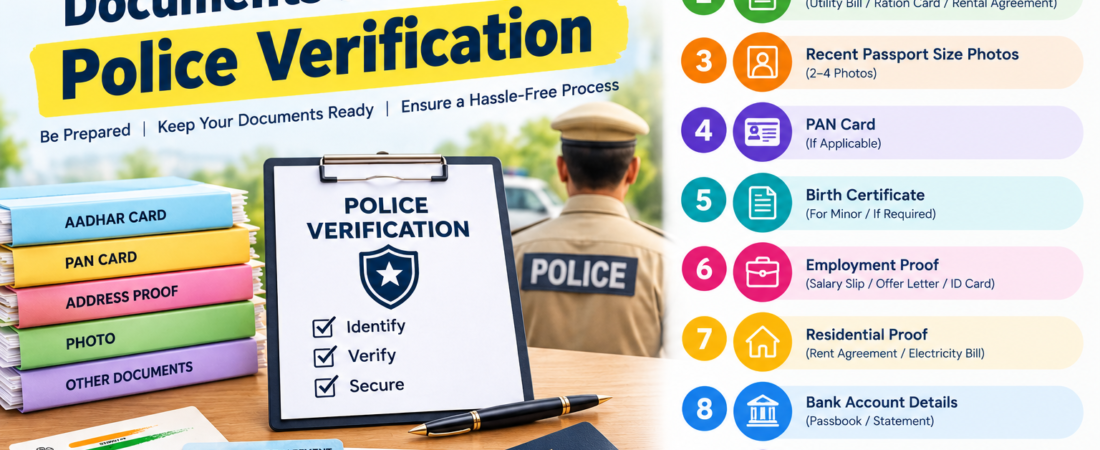
Police verification is an important process required for several official purposes in India, including passport applications, employment, tenant verification, address verification, immigration, and other government or private services. During police verification, the authorities generally verify a person’s identity, residential address, and other relevant details based on the purpose of the verification.
One of the most important parts of the process is keeping the required documents ready. Missing or incorrect documents can cause delays and may require you to visit the concerned police station again.
In this guide, we explain the Top 10 documents needed for police verification, along with useful preparation tips to help make the process easier.
What Is Police Verification?
Police verification is a process in which the police authorities verify information provided by an individual. Depending on the purpose, verification may include checking the applicant’s identity, current address, permanent address, employment details, or other information.
For example, police verification may be required for:
- Passport applications
- Employment verification
- Tenant verification
- Domestic worker verification
- Address verification
- Immigration-related requirements
- Government-related applications
- Certain licenses and official procedures
The exact requirements can differ depending on the state, police department, and purpose of verification. Therefore, applicants should check the instructions provided by the concerned authority.
Top 10 Documents Needed For Police Verification
1. Aadhaar Card
An Aadhaar Card is one of the commonly used identity and address documents in India. It can help establish the applicant’s identity and, where the address is current, provide address information.
Before submitting your Aadhaar Card, check that the details such as your name, date of birth, and address are correct.
If your Aadhaar contains an old address, you may need to provide another acceptable document showing your current residential address.
2. Passport
For passport-related police verification, the passport application and supporting documents are particularly important.
Depending on the circumstances, applicants may need to provide their existing passport, passport application details, or other documents requested by the concerned authorities.
If you are applying for a new passport, make sure the information submitted during the application process is accurate and consistent with your supporting documents.
3. Address Proof
Address proof is an important part of many police verification processes. Authorities may need to confirm where you currently live.
Common documents that may be accepted as address proof include:
- Aadhaar Card
- Voter ID
- Driving Licence
- Utility bill
- Bank statement
- Registered rent agreement
- Other government-issued address documents
The accepted documents can vary according to the purpose and local requirements.
If you have recently moved to a new residence, make sure your address information is updated wherever necessary.
4. Identity Proof
A valid identity proof helps authorities confirm that the person appearing for verification is the same person mentioned in the application.
Common identity documents may include:
- Aadhaar Card
- PAN Card
- Passport
- Voter ID
- Driving Licence
- Other government-issued identification
Carry the original document whenever required and keep a clear photocopy or digital copy if the concerned authority permits it.
5. Passport-Size Photographs
Passport-size photographs may be required for certain types of police verification. The number, size, background, and format of photographs can depend on the specific application.
It is useful to keep a few recent photographs available, particularly when submitting documents physically.
Make sure the photographs are recent and clearly show your face.
6. Rent Agreement or Proof Of Residence
If you are staying in a rented property, a rent agreement can be useful for establishing your residential details.
A registered or otherwise legally appropriate rent agreement may be requested depending on the purpose and local requirements.
For tenant verification, authorities may also ask for additional information about the property owner, tenant, or occupancy.
Before submitting a rent agreement, check that important details such as the tenant’s name, landlord’s name, property address, and agreement dates are correct.
7. Employment or Company Documents
For employment-related police verification, you may be asked to provide documents connected with your job or employer.
Depending on the purpose, these may include:
- Employment letter
- Offer letter
- Employee ID
- Company identification
- Appointment letter
- Employer verification letter
These documents can help establish your employment information when employment verification is part of the process.
If your employer has provided specific instructions regarding police verification, follow those requirements carefully.
8. Educational or Supporting Certificates
In some cases, educational certificates or other supporting documents may be requested, particularly when verification is connected with employment, professional requirements, or a specific application.
Examples can include:
- Educational certificates
- Degree certificates
- Professional certificates
- Training certificates
- Other relevant supporting documents
Not every applicant will need these documents. Their requirement depends on the purpose of the police verification.
9. Application Form or Verification Reference
The application form, acknowledgement receipt, application number, or verification reference can be important during the process.
If your police verification is connected with an online application, keep the following information available:
- Application number
- Reference number
- Appointment details
- Acknowledgement receipt
- Application copy
- Relevant SMS or email confirmation
These details can help authorities locate your application and verify the purpose of your visit.
10. Additional Documents Requested By Authorities
The tenth and most important category is any additional document specifically requested by the concerned authority.
Depending on your situation, you may be asked for additional documents related to:
- Current residence
- Previous residence
- Employment
- Identity
- Citizenship
- Family details
- Property or tenancy
- Previous application records
This is why it is important not to rely on a single generic document list. The documents needed for police verification can vary according to the purpose and location.
Documents Required For Police Verification: Quick Checklist
Before attending police verification, prepare a document folder containing:
- Aadhaar Card
- Passport, if applicable
- Address proof
- Identity proof
- Passport-size photographs
- Rent agreement, if applicable
- Employment documents, if applicable
- Educational or supporting certificates, if requested
- Application or acknowledgement receipt
- Any additional document requested by the authority
Keep both the original documents and photocopies ready when physical submission is required.
How To Prepare For Police Verification
Preparing your documents properly can make the process easier. Follow these simple steps.
Check Your Personal Details
Check your name, date of birth, address, and other important information across your documents. Differences in spelling or other details may require clarification.
Keep Your Current Address Updated
Your residential address is often an important part of verification. Make sure you have valid proof of your current address.
Organize Your Documents
Keep documents in a logical order. Place the most important identity and address documents at the beginning of your folder.
Carry Original Documents
If physical verification is required, carry original documents for inspection along with photocopies where appropriate.
Keep Application Details Handy
Save your application number, reference number, appointment information, and relevant communication on your phone or in printed form.
Follow Local Instructions
Requirements can vary depending on the purpose of verification and the concerned police authority. Always follow the instructions provided with your application.
Common Reasons For Police Verification Delays
Police verification may take longer when information or documents require clarification. Common issues can include:
- Incorrect address details
- Incomplete documentation
- Differences in personal information
- Missing supporting documents
- Recent change of address
- Unclear photocopies
- Incorrect application information
- Unavailability of the applicant when verification is attempted
Providing accurate information and keeping supporting documents ready can help reduce avoidable issues.
Is A Rent Agreement Required For Police Verification?
A rent agreement may be useful when you live in a rented property and need to establish your current residential address. However, it is not universally required for every type of police verification.
Whether a rent agreement is required depends on the purpose of verification and the requirements of the concerned authority.
If you are a tenant, keeping a valid rent agreement and other acceptable address proof available can be helpful.
Can Police Verification Be Completed Online?
Some police departments and government services provide online facilities for submitting applications or initiating verification. However, the exact process varies depending on the service and location.
Online application does not necessarily mean that physical verification will not take place. In some cases, an officer may still need to verify the applicant’s address or documents.
Always follow the instructions given by the relevant government department or police authority.
Tips For A Smooth Police Verification Process
Here are some practical tips to remember:
- Keep your documents updated.
- Check your address carefully.
- Carry original documents when requested.
- Keep photocopies ready.
- Save your application reference number.
- Provide accurate information.
- Respond promptly to verification requests.
- Follow the instructions of the concerned authority.
- Keep additional supporting documents available.
- Avoid submitting incorrect or misleading information.