
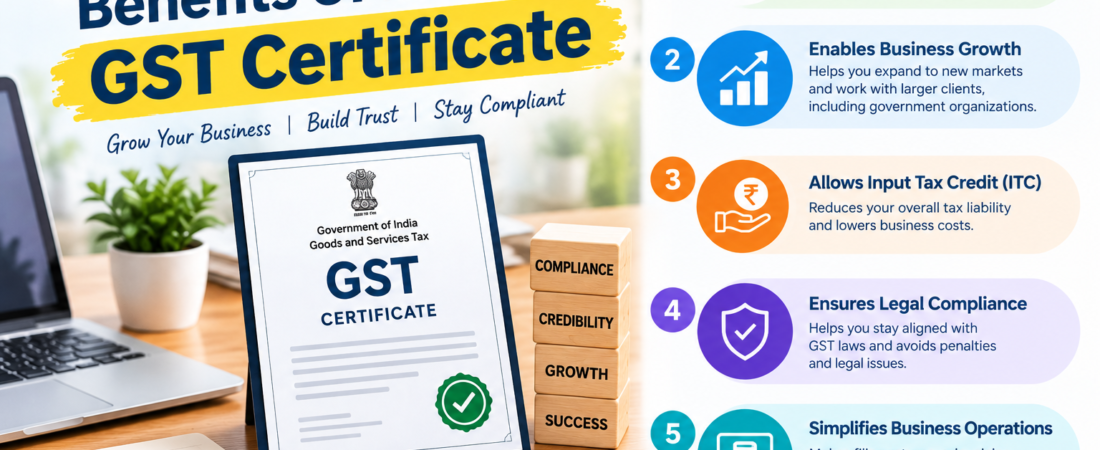
Introduction
For businesses in India, proper tax registration is an important part of operating in a structured and compliant manner. A GST Certificate is an official document issued after successful GST registration. It confirms that a business or taxpayer is registered under the Goods and Services Tax system and includes important registration details such as the GSTIN.
For eligible businesses, obtaining GST registration is an important compliance requirement. Some businesses may also choose registration voluntarily depending on their business needs and applicable rules.
But what are the actual advantages of having a GST certificate?
In this blog, we will discuss the Top 5 Benefits Of Having GST Certificate and explain how GST registration can support business operations, invoicing, input tax credit, and professional credibility.
Note: GST rules, registration requirements, thresholds, and compliance provisions can change. Businesses should check the latest requirements applicable to their specific situation before applying.
What Is A GST Certificate?
A GST Certificate is the registration certificate issued to a taxpayer after GST registration is granted. The GST Portal states that registered taxpayers receive a GST Registration Certificate in Form GST REG-06, which can be downloaded online from the GST Portal.
The certificate contains important information associated with the registration, including the GSTIN, type of registration, date of issue, and other registration details.
The GSTIN, or Goods and Services Tax Identification Number, is an important business identification number used for GST-related transactions and compliance.
Having a valid GST registration can therefore be important for businesses that are required to register or that obtain registration voluntarily.
Top 5 Benefits Of Having GST Certificate
1. Builds Business Credibility
One of the important benefits of having a GST Certificate is that it can help establish greater credibility for a business.
When customers, suppliers, or other businesses see that a business has a valid GST registration, they can verify its GSTIN and registration details through the GST system.
For businesses dealing with other companies, wholesalers, distributors, or institutional customers, proper tax registration can provide a more organized and professional appearance.
A GST-registered business can also issue tax invoices where applicable. GST invoice rules require registered persons issuing tax invoices to include details such as the supplier’s name, address, and GSTIN.
This makes GST registration particularly relevant for businesses that regularly conduct B2B transactions.
2. Helps Claim Eligible Input Tax Credit
Another major benefit associated with GST registration is the ability to claim eligible Input Tax Credit (ITC), subject to the conditions and restrictions prescribed under GST law.
Input Tax Credit allows an eligible registered taxpayer to claim credit for GST paid on qualifying business purchases and expenses against applicable output tax liability.
For example, a registered business may purchase goods, services, equipment, or other business-related items on which GST is charged. Where the relevant legal conditions are satisfied, the eligible input tax may be available as credit.
CBIC rules specify documentary and other conditions for claiming ITC, including requirements relating to tax invoices and other prescribed documents.
It is important to understand that GST registration does not automatically mean every GST payment becomes eligible for credit. ITC is subject to applicable provisions, documentation, eligibility conditions, and restrictions.
Therefore, businesses should maintain proper invoices and accounting records and verify ITC eligibility before claiming it.
3. Enables Proper GST Tax Invoicing
GST registration is important for businesses that need to issue GST tax invoices for taxable supplies.
A proper tax invoice provides customers with details such as the supplier’s GSTIN, invoice number, date, description of goods or services, taxable value, applicable tax rate, and tax amount. These requirements are specified under GST invoice rules.
For businesses serving other GST-registered businesses, correct invoicing can be especially important because the recipient may need the invoice to support its own eligible ITC claim.
Professional GST invoicing can also help businesses maintain organized financial records.
For example, a GST invoice can clearly show:
- Business name and address
- GSTIN
- Invoice number
- Invoice date
- Description of goods or services
- HSN or SAC details, where applicable
- Taxable value
- Applicable GST rate
- GST amount
- Customer details, where required
Maintaining proper invoices can make GST-related accounting and record keeping more systematic.
4. Supports Business Expansion And B2B Opportunities
GST registration can become increasingly relevant when a business starts expanding its customer base.
Many businesses work with companies that prefer or require suppliers to provide proper GST invoices and registration details. Having GST registration can therefore make it easier for a business to participate in certain B2B transactions, subject to the specific requirements of the customer and applicable law.
For example, a small business may initially serve individual customers. As it grows, it may begin supplying products or services to:
- Companies
- Retail chains
- Distributors
- Wholesalers
- Manufacturers
- Institutions
- Other GST-registered businesses
In such situations, GST registration and proper invoicing can become an important part of the business process.
GST registration can also help create a more structured foundation for businesses planning to expand their operations.
However, businesses should remember that GST registration by itself does not guarantee contracts, customers, tenders, loans, or business growth. Those opportunities depend on the individual requirements of the organization or platform involved.
5. Provides Official Proof Of GST Registration
A GST Certificate serves as official evidence that a taxpayer has been granted GST registration.
The GST Portal provides registered taxpayers with access to their registration certificate online. The certificate can be downloaded in PDF format through the GST Portal.
This makes the certificate a useful business document that can be maintained with other important records.
A GST registration certificate can contain information such as:
- GSTIN
- Legal name of the business
- Trade name, where applicable
- Principal place of business
- Type of registration
- Date of issue
- Registration-related details
If business information changes, the GST registration details may also need to be amended according to the applicable GST procedures.
Keeping an updated registration certificate can help businesses maintain accurate records and provide registration information when required.
Who May Need GST Registration?
GST registration requirements depend on factors such as the nature of business, turnover, type of supply, location, and other provisions under GST law.
Some businesses may be required to register when they become liable under the applicable provisions, while others may be eligible for voluntary registration.
Because GST registration rules can differ according to circumstances, businesses should not rely only on a general turnover figure when deciding whether registration is required.
The official GST registration process requires information such as PAN, email address, mobile number, business details, and other applicable information.
Before applying, it is advisable to understand the registration requirements applicable to your business.
Documents Generally Required For GST Registration
The exact documents required can vary depending on the type and constitution of the business.
Common information and documents may include:
- PAN of the business or proprietor
- Aadhaar or applicable identity details
- Mobile number
- Email address
- Business address proof
- Photograph of promoters or authorized persons, where applicable
- Bank account details, where required
- Business constitution documents
- Details of goods or services
- Authorization documents, where applicable
The GST Portal registration process includes sections covering business details, promoters or partners, authorized signatory, principal place of business, goods and services, and other relevant information.
Applicants should always check the latest GST Portal requirements before submitting an application.
How To Get A GST Certificate Online?
GST registration is generally completed through the official GST Portal.
The basic process involves:
Step 1: Visit The GST Portal
Access the official GST Portal and select the registration option.
Step 2: Enter Basic Details
Provide the required information, including PAN, state or Union Territory, email address, and mobile number.
Step 3: Complete OTP Verification
The GST registration process includes verification through OTPs sent to the registered mobile number and email address.
Step 4: Complete The Registration Application
Enter the required business, promoter, authorized signatory, address, goods and services, and other applicable details.
Step 5: Submit The Application
After completing the required information and verification, submit the application through the GST Portal.
Step 6: Download The GST Certificate
Once registration is granted, the GST Registration Certificate can be downloaded from the GST Portal. The official GST guidance provides the option under Services > User Services > View/Download Certificates.
Because GST applications involve legal and tax information, applicants should carefully verify all details before submission.
Why Choose Online GST Registration Services?
GST registration can involve several steps, documents, verification requirements, and online procedures.
For business owners who are unfamiliar with the process, professional assistance can make the documentation and application process more convenient.
Kingaa Web Services Pvt Ltd provides online documentation and business-related services, including assistance related to GST services, rent agreements, Aadhaar, PAN, and other online documentation requirements.
Professional assistance can be useful for:
- Understanding the basic registration process
- Preparing required information
- Organizing documents
- Completing online application details
- Checking application information before submission
- Understanding the next steps
However, the approval of a GST registration application is subject to the applicable GST rules and verification by the relevant authorities.
GST Certificate: Important Things To Remember
Getting a GST Certificate is only one part of GST compliance.
After registration, a taxpayer may have ongoing responsibilities depending on the type of registration and business activity. These can include maintaining records, issuing appropriate invoices, filing applicable returns, paying tax where due, and complying with other GST requirements.
Therefore, businesses should not treat GST registration as a one-time activity.
It is also important to keep your business information updated and monitor notifications and changes issued through the official GST system.
Frequently Asked Questions About GST Certificate
What Is A GST Certificate?
A GST Certificate is the registration certificate issued to a taxpayer after GST registration is granted. Registered taxpayers can download the certificate online from the GST Portal.
What Is GSTIN?
GSTIN stands for Goods and Services Tax Identification Number. It is the unique GST registration number associated with a registered taxpayer.
Can I Download My GST Certificate Online?
Yes. The GST Portal allows registered taxpayers to view and download certificates online in PDF format.
Does GST Registration Provide Input Tax Credit?
Eligible registered taxpayers may claim Input Tax Credit subject to the applicable GST law, rules, documentation, and other conditions. ITC should not be assumed to be available on every purchase.
Is GST Registration Mandatory For Every Business?
No. Whether GST registration is mandatory depends on the applicable GST provisions and the specific circumstances of the business. Some businesses may also register voluntarily.
Conclusion
A GST Certificate is an important document for businesses that are registered under the GST system. The key benefits include establishing business credibility, supporting eligible Input Tax Credit claims, enabling proper GST invoicing, supporting certain B2B business opportunities, and providing official proof of GST registration.
For businesses planning to grow, maintain organized financial records, and work with GST-registered customers or suppliers, understanding GST registration can be an important part of business planning.
If you are looking for assistance with online GST services, PAN, Aadhaar, rent agreement, and other documentation services, Kingaa Web Services Pvt Ltd can help you understand the online process and documentation requirements.
For the latest GST rules and registration requirements, always refer to the official GST Portal and applicable government notifications.