
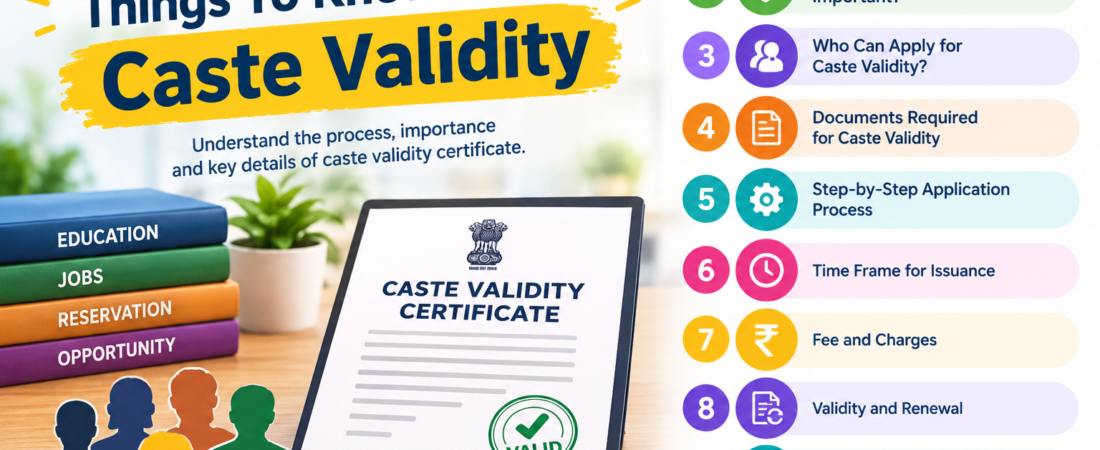
A Caste Validity Certificate is an important document used to verify a person’s caste certificate for various educational, employment, election, and government-related purposes. Many students, job applicants, and citizens need caste validity when applying for benefits available to eligible reserved-category applicants.
Understanding the caste validity certificate process, required documents, verification procedure, and application requirements can help you avoid unnecessary delays.
In Maharashtra, the Caste Certificate Verification Information System (CCVIS) provides an online system for submitting and tracking caste validity applications for categories such as education, service, election, and other purposes.
In this guide, we explain the Top 10 Things To Know About Caste Validity before applying.
1. What Is A Caste Validity Certificate?
A Caste Validity Certificate is issued after the concerned authority verifies the caste certificate and supporting evidence submitted by an applicant.
A caste certificate and a caste validity certificate are not necessarily the same document. The caste certificate establishes the caste claim through the competent authority, while the validity process involves verification by the appropriate scrutiny committee.
In Maharashtra, caste certificate verification is handled through designated District Caste Certificate Scrutiny Committees. The CCVIS system supports online applications for education, service, election, and other purposes.
Therefore, if an institution or authority specifically asks for a caste validity certificate, applicants should check the applicable requirements before submitting their application.
2. Why Is Caste Validity Important?
Caste validity may be required when an eligible person wants to claim certain benefits or concessions connected with a reserved category.
Depending on the purpose, it can be relevant for:
- Educational admissions
- Scholarships and educational benefits
- Government employment
- Reserved-category employment benefits
- Certain elections
- Government schemes and other specified purposes
The Maharashtra CCVIS portal specifically provides application categories for Student, Service, Election, and Other purposes.
Because requirements can differ according to the purpose of the application, applicants should select the correct category and provide the supporting documents requested for that category.
3. Documents Are Very Important
One of the most important parts of the caste validity process is documentary evidence.
For Maharashtra applications, the official document checklist can include the applicant’s caste certificate, birth-date evidence, school records, and relevant records of paternal-side relatives. Depending on the circumstances, additional supporting documents may also be required.
Commonly relevant documents may include:
- Caste certificate
- Birth certificate or birth-date proof
- Applicant’s school leaving certificate
- Father’s school leaving certificate or school register extract
- Grandfather’s school record
- Records of paternal-side relatives
- Relevant affidavits
- Other supporting documentary evidence
Not every applicant will have identical documents. If older family records are unavailable, alternative evidence may be considered according to the applicable procedure.
Before applying, arrange your documents carefully and make sure names, dates, and other important details are consistent wherever possible.
4. Old Family Records Can Be Valuable
Historical documents can play an important role in caste verification.
For example, old school records, school leaving certificates, birth or death records, revenue records, and other documents may help establish the applicant’s caste claim and family history.
The official Maharashtra CCVIS documentation lists school records of the applicant and paternal-side relatives among important documentary evidence. It also identifies certain secondary evidence that may be considered where primary documentary evidence is unavailable.
This is why applicants should not ignore old family documents.
If you are preparing a caste validity application, check your family records in advance. Collecting documents before starting the application can make the process more organized.
5. Caste Validity Application Can Be Submitted Online
Maharashtra’s CCVIS portal provides an online facility for caste validity applications.
The system supports applications for different purposes, including education, service, election, and other specified purposes. Applicants can also track their application status through the system.
The general process involves:
- Selecting the appropriate application category.
- Registering or logging into the system.
- Completing the application form.
- Uploading or submitting the required documents.
- Reviewing the information carefully.
- Submitting the application.
- Tracking the application status.
- Responding to any additional requirements, if applicable.
Always check the current official portal instructions before submitting an application because forms, notices, and requirements can change.
6. Verification Is Done By The Scrutiny Committee
A caste validity application is not simply an online form submission. The supporting information and documents are subject to verification by the appropriate scrutiny authority.
Under Maharashtra’s caste certificate verification framework, Scrutiny Committees are constituted to verify caste certificates and issue validity certificates where the claim is found valid.
The verification process may involve examining documentary evidence and, where necessary, conducting further inquiry.
This makes accurate documentation extremely important. Applicants should provide genuine records and avoid submitting documents containing incorrect or misleading information.
7. Processing Time Can Vary
Many applicants want to know how long a caste validity certificate will take.
The Maharashtra CCVIS help information states that the District Caste Certificate Scrutiny Committee shall take its decision and issue the validity certificate within three months from submission to the respective committee, with an additional period of up to two months in exceptional circumstances.
However, applicants should not assume that every application will be completed in exactly the same timeframe.
Processing can depend on factors such as:
- Completeness of documents
- Verification requirements
- Availability of historical records
- Objections or discrepancies
- Additional inquiry
- Application category
- Instructions issued by the relevant authority
For this reason, it is better to apply well before an admission, employment, or other deadline.
8. Avoid Incorrect Or Fake Documents
Document accuracy is one of the most important aspects of caste validity verification.
Applicants should submit only genuine documents and truthful information. Incorrect information, altered records, or false documents can create serious legal and administrative problems.
The Maharashtra CCVIS portal itself warns applicants about the consequences of submitting false documents or records.
If you are unsure about a document, do not modify it yourself. Instead, verify the requirement with the appropriate authority or obtain professional assistance for document preparation and submission.
Accuracy is always more important than simply completing an application quickly.
9. Track Your Caste Validity Application
After submitting your application, keeping track of its status is important.
The Maharashtra CCVIS system provides an online application tracking facility where applicants can use their application information to check the status.
Regular tracking can help you identify whether:
- Your application has been received
- Additional information is required
- Documents need attention
- The application is under verification
- A decision has been issued
Keep your application number and other relevant details safely stored after submission.
If your application is connected with an admission or employment deadline, do not wait until the last moment to check its progress.
10. Apply Early And Keep Your Documents Ready
The final and perhaps most practical point is simple: do not wait until the last date.
Students may need caste validity for admission-related requirements, while employees or candidates may need it for employment-related purposes. Since verification can require examination of historical documents, starting early can give you more time to resolve documentation issues.
Create a checklist before beginning your application.
Caste Validity Document Checklist
- Applicant’s caste certificate
- Birth-date proof
- School records
- Father’s records
- Paternal-side family records
- Relevant affidavits
- Supporting historical documents
- Purpose-related documents
- Application details
- Copies of submitted records
Keep both physical and digital copies of important documents where appropriate.
Common Mistakes To Avoid During Caste Validity Application
Applicants can reduce avoidable problems by checking their application carefully before submission.
Some common mistakes include:
1. Incorrect Personal Details
Check your name, date of birth, address, caste details, and other information before submitting the form.
2. Missing Documents
Review the applicable checklist carefully and ensure that required documents are available.
3. Poor Quality Scans
If documents are being uploaded online, ensure that scans or photographs are readable and meet the portal’s requirements.
4. Inconsistent Family Records
Differences in names or other details across historical documents may require clarification. Do not alter original records.
5. Applying Too Late
Start the process early, particularly if the certificate is needed for an admission or employment deadline.
6. Selecting The Wrong Application Purpose
Maharashtra’s CCVIS system provides different application categories, including education, service, election, and other purposes. Select the category that matches your actual requirement.